
Understand London’s padel coaching market, from salaries and job demand to competition and what clubs look for when hiring.
London’s Padel Boom: What Does It Actually Mean for Coaches?
Britain has just passed an important milestone in the development of padel, with more than one million adults and juniors now playing padel in Britain, across 551 venues. For London, the figure is difficult to ignore. The capital has become one of the most important markets within Britain’s wider padel expansion, with courts and clubs appearing across different parts of the city. However, there is something slightly unusual about London’s position.
London should not be grouped with new padel markets
When talking about the global padel boom, London is often grouped together with countries and cities where the sport has only recently begun to establish itself. That comparison misses an important distinction; padel is not new to Britain. The sport had an established presence long before the current wave of club openings, investment and mainstream attention. The British Padel Association was, in fact, established in 1992. London had dedicated courts and clubs long before the current wave of investment. The LTA (Lawn Tennis Association), the national governing body for tennis and padel, arrived in 2019 and did not introduce Londoners to padel. It brought greater structure, investment, visibility and a national development strategy to a sport that was already here.
What makes London different is that the padel industry is only just entering the scaling phase. The LTA recently stated that Britain was entering a more mature phase of padel development, with demand for high-quality qualified coaches and activators. The LTA has created formal qualifications for both group instruction and individual player development, supported by a rapidly growing coaching workforce. By March 2026, 1,676 coaches had completed their Intro to Padel Coaching CPD, and 427 had completed Padel Instructor Core Training.
This distinction matters for coaches looking to explore London as their next career breakthrough. In a genuinely new padel market, simply having extensive experience in the sport can make an international coach valuable. However, as the padel market in London matures, the question becomes less about whether London needs padel coaches and more about what kind of coaches it needs.
Where do international coaches fit into London’s market?
Britain is building its own coaching workforce alongside the growth of the sport, which means London is no longer a market where international experience alone guarantees an advantage. Local coaches are gaining qualifications, experience and familiarity with the players they serve, while the market itself is becoming more specialised.
Discover the countries to build your coaching career.
London’s coaching market is showing increasingly distinct roles and salary bands, from working with recreational players to leading coaching programmes and developing competitive athletes. International coaches therefore have an opportunity that extends beyond filling a basic shortage: bringing experience to a domestic market that is still developing.
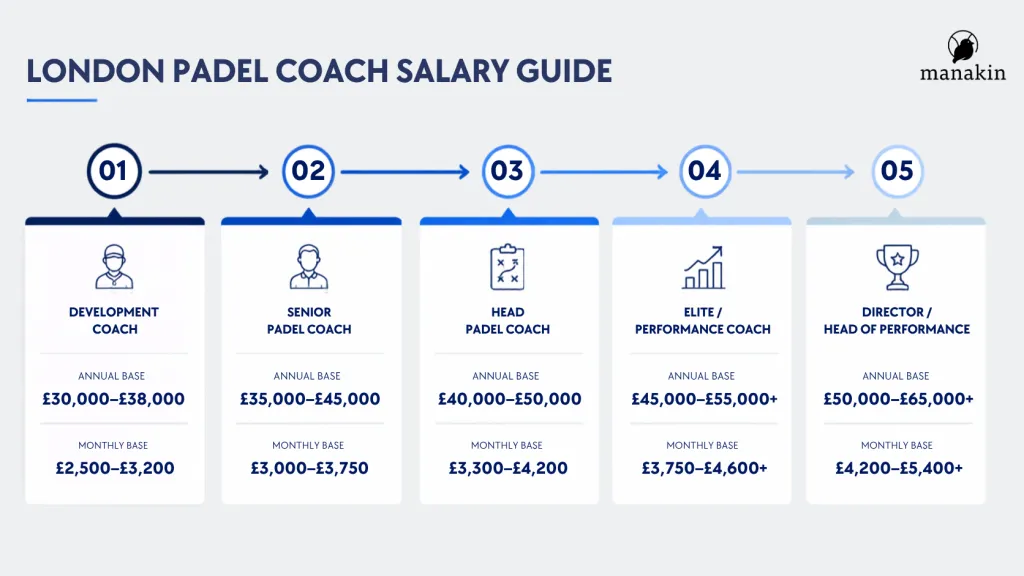
These distinctions are also reflected in what clubs are prepared to pay. Below is an indicative guide to London padel coaching salaries, drawn from publicly available job listings and advertised roles. Compensation structures vary between clubs, particularly where private lessons, commissions and performance incentives are involved. Thus, these figures should be read as market benchmarks rather than fixed industry rates.
London padel coach salary guide
Indicative base salary ranges based on advertised London coaching roles and market benchmarks.
London promises a career, not just a job
As coaching opportunities emerge across rapidly growing padel markets, including Southeast Asia, where does London fit within the expanding range of opportunities available to coaches internationally? The answer may lie in the distinction between finding a job and building a career.
London offers an increasingly structured padel ecosystem: established club operators, recognised coaching qualifications, competitive pathways, academies, major events and a growing domestic coaching workforce. For a coach serious about the long-term trajectory of their career, that structure creates opportunities to progress beyond delivering lessons. One may expect to expand into roles such as senior coaching, performance development, academy leadership, Head Coach positions and, eventually, wider management roles.
London also offers greater potential for stability. Emerging markets can offer attractive relocation packages and the excitement of helping build a sport from its early stages. Still, London provides access to a large and increasingly established player base within a regulated sporting system. Experience gained in this environment can build a coach’s professional credibility, network and understanding of both the sporting and commercial sides of padel.
London also positions coaches close to one of the most internationally connected sporting markets in the world. A coach can work with recreational players, competitive athletes and internationally mobile clients while developing relationships across clubs, brands, tournaments and the wider racquet-sports industry. As padel becomes more professionalised, those connections can become as important to career progression as time spent on court.
For coaches looking primarily for their next opportunity, there are an array of compelling destinations around the world. For those looking for progression, professional structure and a more established pathway through the industry, London offers the possibility of not just the next coaching job, but the foundations of a longer career.
What does a London club gain from an international coach?
For a London club, international recruitment should not simply mean looking towards Spain or Argentina for the most technically accomplished coach available. The more interesting opportunity may be in importing a different combination of skills, experience and perspective into the club.
That could certainly be a coach who has spent years within a mature padel system and understands how to structure training, develop players and build an academy. However, selection could also come from a pool of relatively young coaches from other parts of the world whose value extends beyond the court. Consideration could include a degree in sports science, sports marketing or sports management, strong native-level English, and an understanding of how coaching connects with player retention, community development and the wider commercial objectives of a club.
Looking for the right coach for your club? Post a job today.
For London’s increasingly sophisticated club market, that combination can be particularly valuable. Coaches often occupy one of the closest relationships a club has with its customers. Someone who can coach effectively while also understanding programming, communication, events, community, performance data or the commercial mechanics of a sports business can contribute far beyond the hours they spend delivering lessons.
This broadens the definition of what a strong international hire can look like. A decorated playing career may be valuable, but it is not the only form of expertise worth importing. The unexpected appointment, such as a coach with the right mix of padel knowledge, education, communication skills and commercial awareness, may ultimately prove more valuable to a London club than the most obvious name on the shortlist.
Creating longevity in London
The real measure of London’s padel boom will not be how many courts open over the next few years, but what remains once rapid expansion is no longer the story. A sustainable sports industry requires more than facilities and participation. It needs viable careers, strong clubs, qualified professionals, competitive pathways and businesses willing to invest in the people responsible for delivering the sport. Coaches undoubtedly sit at the centre of that ecosystem, turning first-time players into regular ones, regular players into competitors, and courts into communities that people continue returning to.
However, that responsibility does not sit with coaches alone. Clubs need to recruit with a clearer understanding of the people and skills their businesses actually need. Coaches need visibility into where their experience can create the most value. As the market becomes increasingly international, better connections between talent and opportunity will become part of the infrastructure the industry needs.
The strongest version of London’s padel industry will not be built by choosing between domestic and international talent. It will be built by creating an environment in which both can develop, move between opportunities and contribute different forms of experience to the growth of the sport. While a boom creates opportunity, a sustainable industry creates longevity.
Ensuring padel becomes the latter requires everyone within it to play a part, including making it easier for the right coaches and the right clubs to find one another. That is the space Manakin is being built to support: a dedicated place for coaches to make their experience visible, and for clubs to find the people who can contribute to what they are building next.
Coaches looking for work can browse jobs by country. Clubs hiring a coach can post a job or create a club profile.